A Debont center pivot irrigates a full circle from a single fixed point. Five systems work together to make that happen. Knowing what each one does makes routine checks faster and helps catch problems before they cost a watering cycle.
Core systems and how they work
Pivot point
The pivot point is the machine's center of rotation and the inlet for both water and power. It is made up of the center column, the rotating base, the collector ring and the water inlet flange. The center column carries the weight of the machine, and the rotating base lets the whole pivot turn a full 360°. The collector ring keeps power flowing steadily while the machine rotates. The inlet connects to the field supply line, and fertilizer and chemical injection ports can be added there so water, fertilizer and crop protection products are applied in one pass.
Span trusses
Each span is built from hot-dip galvanized steel pipe and truss sections, so it serves as both the water pipeline and the structure that holds it up. The triangular truss design resists wind load and deformation. Spans are joined end to end with sealed flanges, and sprinklers with pressure regulators are mounted at even intervals along the underside, so water is applied evenly across the full width of the machine.
Drive towers
Every span has its own drive tower with wheels, a gear motor, a tower control box and an alignment mechanism. An electric motor and a planetary gearbox drive the wheels. Angle-based alignment control keeps all towers moving together, so the machine stays in a straight line as it rotates around the center and the spans are never bent or pulled out of step.
Sprinkler package
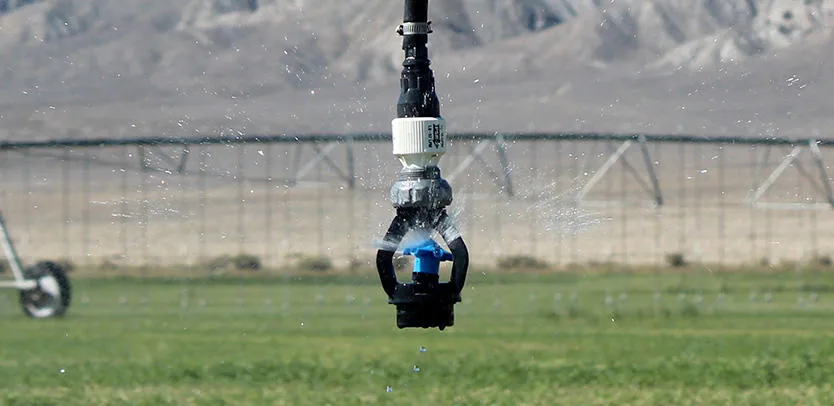
The sprinkler package is made up of pressure regulators, sprinklers, drop hoses and an optional end gun. A separate pressure regulator in front of each sprinkler keeps operating pressure the same at every position along the machine. Nozzles with different flow rates can be fitted to match the crop and its water needs. A long-range end gun can be added to the overhang to extend coverage and reduce dry corners at the field edge. See our sprinkler and end gun options.
Smart control system
The control system includes the main control panel, tower control units, the collector ring, sensors and a remote cloud platform. It supports local manual or automatic operation, speed adjustment and forward or reverse rotation. Built-in protection stops the machine on low water pressure, overload or misalignment. Smart models can be monitored from a mobile app, where you can set irrigation plans and read operating data. They can also link to soil moisture and weather data for precision irrigation.
Daily and weekly inspections during irrigation season
Before each day's operation
- Check that supply pressure is steady and within the machine's rated range, with no sudden rises or drops.
- Confirm the main control panel shows normal voltage and current, with no fault alarms.
- Watch that all towers move in step, and that wheel tracks are not getting unusually deep or drifting off line.
- Check that sprinklers are spraying normally, with no clogging, leaks or irregular spray patterns.
- Listen for unusual noise at the pivot point and look for leaks.
Weekly inspection
- Tighten span flange and tower connection bolts, and check for any that are loose or missing.
- Check tire pressure and keep it at the manufacturer's specified value. Tread should be free of severe wear and cuts.
- Check the gear motors for unusual noise or abnormal heat, and make sure wiring is secure.
- Clean the inlet filter screen so debris does not clog the sprinklers.
- Check that the collector ring is clean, free of dust and oxidation, and that the carbon brushes make good contact.